
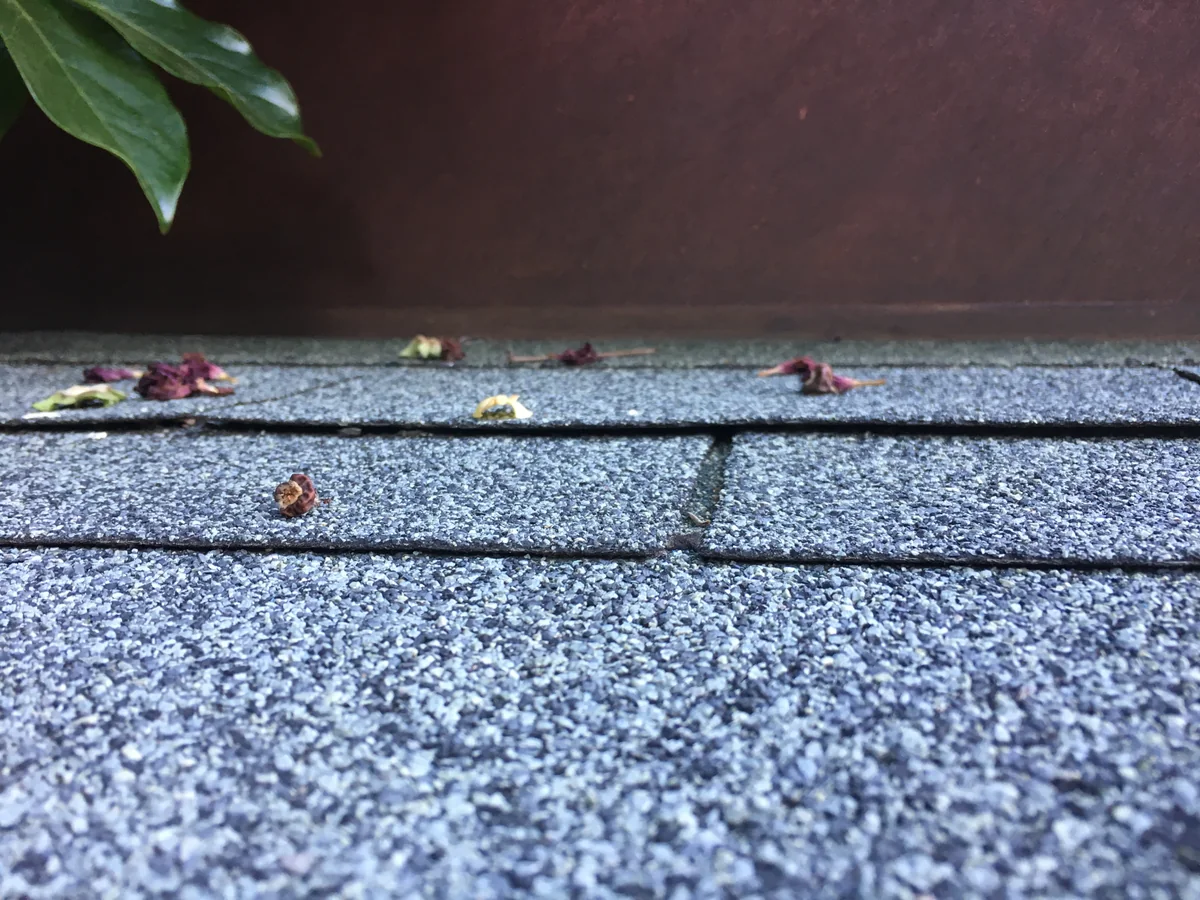

Asphalt shingles: overlapping units.
Asphalt shingle roofs use overlapping shingle units. The DOE describes fiberglass asphalt shingles as having a granule-coated surface. That visible texture is different from the smooth sheet appearance of many metal roofs. Shingle appearance, color and product design can vary within the same material family.
A familiar-looking surface does not tell you which underlayment, edge treatment or flashing was used. It also does not tell you how the roof has been maintained. When talking with a professional, ask for the exact product and the proposed system around it, not just the label “shingle roof.”
Background: DOE Guidelines for Selecting Cool Roofs (July 2010 PDF) · NRCA Guidance for homeowners (October 2020 article PDF)
Metal: a material with several surface forms.
Metal roof surfaces may have a natural metal finish, a painted finish or a granule-coated surface. The DOE describes metal options for both low- and steep-slope roofs. A long-panel standing-seam photograph illustrates one appearance, not the entire metal-roof category.
Do not infer a cool-roof rating from shine or a light color. The DOE distinguishes reflectance from thermal emittance, and explains that bare shiny metal does not behave like every painted metal surface. The exact finish matters to that conversation. Our cool-roof chapter explains the two terms without recommending a product.
Background: DOE Guidelines for Selecting Cool Roofs (July 2010 PDF)
Tile and slate: ask for the exact material.
The DOE cool-roof guide discusses clay, slate and concrete tile surfaces. Natural material and surface treatment can affect appearance and reflectance. A tile-shaped profile alone is not enough to identify the material or to know whether it belongs on a particular home.
A useful professional conversation names both the surface and the home-specific constraints. Ask which materials are actually being considered and what must be assessed before a change. This guide does not determine structural suitability, local requirements or the right assembly for a building.
Background: DOE Guidelines for Selecting Cool Roofs (July 2010 PDF)
Low-slope surfaces have their own vocabulary.
Not every home has a visibly steep roof. The DOE describes single-ply membranes, built-up roofs and modified-bitumen sheet systems among common low-slope options. “Membrane” refers to a sheet-type roofing material in this context, not a synonym for every roof surface.
These families differ in composition and surface treatment. A broad material category is an introduction to the terminology, not permission to substitute one system for another. Ask a professional to explain the proposed system in plain language and to identify the specific materials.
Background: DOE Guidelines for Selecting Cool Roofs (July 2010 PDF)
Compare questions, not a universal winner.
There is no “best material” table here. The same general label can cover different products and assemblies, while an individual home brings its own conditions. Instead, use the comparison below as a discussion aid.
| Surface family | Useful clarification |
|---|---|
| Asphalt shingles | Which exact shingle and supporting system are proposed? |
| Metal | Which panel or unit form and which finish are being discussed? |
| Tile or slate | Which material is this, and what home-specific assessment is needed? |
| Membrane or built-up | Which complete low-slope system is proposed, rather than which generic surface? |